March 22, 2013

Gold, Boats, and Forts

I'm just getting to finishing up our posts on Colombia now so bear with me. Thanks! ~Ayelet

We spent our last few days on vacation in the town of Cartagena, right along the coast. In a way, I felt like our vacation only started when we got to Cartagena.

Watching the sunset on century-old city walls
Why?

Because 1) it's warm and humid, 2) the people are super nice, 3) it was easy to walk around and felt safe within the old city walls, and 4) there was a variety of things to see and do.

One morning we spent some time in the old fortress on the hill. Cartagena was where Spanish kept all the gold they stole from the indigenous people before they shipped it back to Spain. So pirates loved to raid the city, or at least try to. The old city is faced on 2 sides by water and is protected by the city walls. The fortress on the hill protects the back sides of the city. We had a great tour guide at the fortress - at one point, he had us go down a dark maze to show how the military communications worked back then. And then he let us flounder our way out of the maze and scare us half to death in the process. Fun times!

Leading to the mazes below the fortress
On another day, we took a boat tour to a few islands off the coast. It took 2 hours to get out there, but let me tell you, this guy was the most entertaining guide/boat game show host we've ever had. We've got video, which we hope to eventually put together, but for now, I'll share this photo of just one part of this voyage.

Yes, those are two men who are cross-dressed up in women's clothes from female volunteers on the boat. They even have lipstick on and stuffed towels up their butts. Then, they were made to walk the "catwalk" and even dance with a pole. And I just want to say that the North American/European tourists were in the minority on this boat. That afternoon, after the boat, we ate lunch on Playa Blanca and relaxed on the beach under a cabana. It was perfect.

Because it was really hot in Cartagena one afternoon (actually, who am I kidding? It was hot every afternoon so we took our siesta usually between 1-3 pm), we stopped by the Museo de Oro (Gold Museum). To our surprise, it was an air-conditioned museum delight! The first floor was about the Zenu Indian tribe, which had goldsmiths quite early. They were around 200 BC to 1600 AD although there are a few remaining members still around today. It was amazing to me that they had an advanced enough society to use gold and have enough wealth to pay for gold jewelry during that time. When you hear about modern civilization, you don't hear about how advanced the non-European societies actually were.

Gold earrings that both women and men wore 
On the second floor, there was a section that talked about how they created a canal system over 400,000 hectares (almost a million acres) of land in northern Colombia because it would keep flooding. They carved out canals in their lands so their crops would still get the nutritional benefits of being in the flood plains, but their houses and villages were safe on the canal ridges. It's interesting because even today, people often build in places that are almost guaranteed to flood without taking precautions.

We were not expected Cartagena to have so much to do and see. We were pleasantly surprised.

March 17, 2013

Portrait of a Painter

Around the time Luis Martinez started painting (late 1800s, early 1900s), Ecuador was still establishing itself as a nation. So his paintings of countrysides could be seen as a way of marking Ecuadorian territory, if only in the public sentiment. He showed Ecuadorians and the rest of the world what Ecuador was (after all, this was during a time when people couldn't just hop a plane or even a bus).

Martinez was a mountain climber, which gave a lot of realism to his art. But his paintings were definitely romantic - you can see a lot of inferences to the presence of God in his work. The sky in many of his paintings take up a third to half of the piece. And there's a lot of golden, heavenly light in there, too.
Another thing he was really good at was working in a play of light and shadow to create depth and add distance to his pieces.
He saw his work as a scientific document - he was not just painting a pretty picture, but more importantly, showing everyone what these mostly unseen landscapes looked like.

El Altar in the early 1900s
View of El Altar in 2008, taken by Ivan Layedra P
Even in modern times, his paintings have this aspect of a scientific document to them. His work gives us a view into this part of the world before industries and people began polluting and causing great changes in the atmosphere. He painted mountains with snow-capped peaks. When we see them today, much of the snow has disappeared. Probably in a few decades, these mountains will be completely bare of snow, leading to huge consequences for the people who live in Ecuador and the rest of South America.

I think his work really conveys the feeling that one gets in the solitude of nature and in the presence of something greater than ourselves. These mountains and landscapes will outlast all of us.

[Paintings from the book "Luis A. Martinez" by Fernando Jurado Noboa]

March 8, 2013

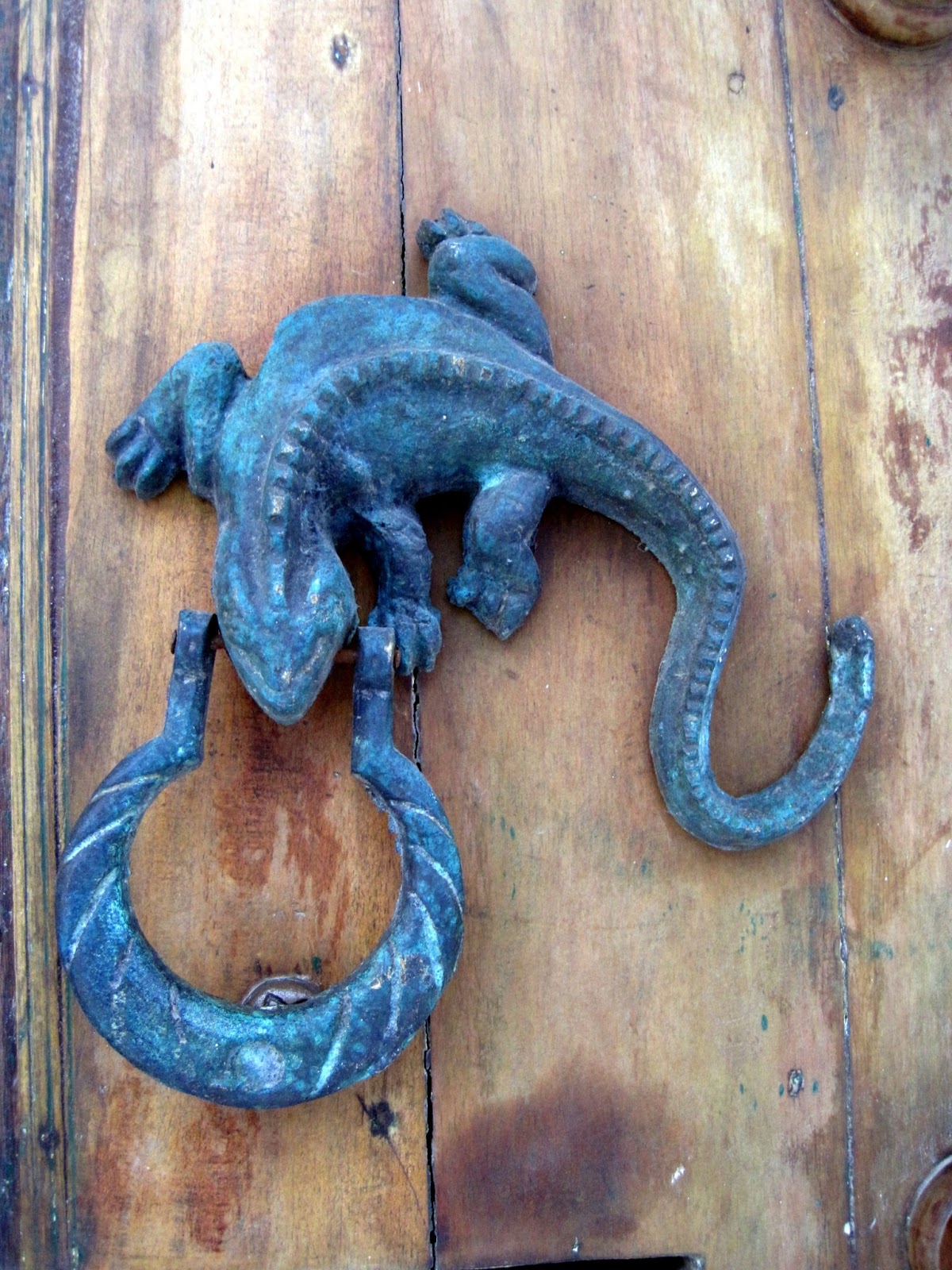
A City Full of Knockers

We appreciate the simple things in life.

So, when we recently vacationed in Cartagena, the knockers really stood out to us. You would probably show up and say, "Wow, these knockers come in all different shapes, sizes, and designs. Where could I get some?" Well, take a close look at our Cartagena tour of knockers.


March 5, 2013

Our Next Adventure...

Greg and I have decided to head back to the US after almost 4 years away. It's been a hard decision and we've had a lot of pros and cons of going somewhere new versus going back home.

Even though we're looking forward to being back in the US, we do miss the excitement that comes at this time of year. Most teachers go to job fairs and get their next overseas gigs right about now. Switzerland, Italy, Qatar, Mexico, Venezuela, Hong Kong, Panama - the world opens up to an international teacher (and his/her spouse :-) for sure.

In the US, our ideal location is Fort Collins, Colorado. For both of us, Colorado now feels like the closest thing to home. We've got great friends there and the landscape is beautiful! We don't have jobs yet, but after our time overseas, we've adapted to tougher situations. If we can't make things happen in Fort Collins, we're open to looking at Denver or other towns.

The biggest challenge for us will be trying to go without a car. One of the best experiences we've had overseas is walking, biking or taking public transit (ok, this part hasn't been fun in Quito). It's so much healthier. I really hope we can make it work in the US. We know we'll need use of a car at some point, but renting or using car sharing are options.

Now, the important thing is to enjoy the next few months without thinking too much about the move back (and all the planning, bureaucracy, closing of accounts, taxes, etc. that goes along with it). I think Scoots also will be very happy to have a more permanent home... and I will be happy to not deal with transferring him to and from different countries.

There are a few other things I look forward to:
  • Seasons - Quito feels like spring most of the time, with a distinct rainy season that's colder, but no snow! I'll probably be sick of it after one snowfall, but whatever, it's SNOW!
  • Grocery stores are open 24/7 (even on Sunday - a big no-no abroad).
  • I can get anything I want in the US. I can't even tell you how many delicious meals I haven't been able to make because they don't have the ingredients in Ecuador (or didn't have them in Germany).
  • Everything will be in English - this is going to make our lives just that much easier.
  • Customer service is amazing in the US. Even the worst customer service agents in the US have nothing on the Germans! The Ecuadorians try to be helpful, but it's just not the same. 
  • We're going to be so much closer to family. I'm already hoping to get home (or NYC) for Rosh Hashanah, the Jewish new year, in September. I haven't been back for at least 4, maybe 5, years and it's one of my favorite holidays.
It's not going to be all fun and games though. There are quite a few things that we're not looking forward to:
  • Our friends who've moved back from being overseas have said adjusting to the American lifestyle (and especially the lack of work-life balance as compared with other countries) is tough. 
  • We're not going to be bombarded by culture and new people all the time. 
  • The health care situation in the US scares me personally. 
  • There seems to be a trend of lack of respect for teachers in the States right now.
  • The general safety in the US (especially idiots with automatic guns) is frightening. 
  • Not enough people seem to be worried about the consequences (environmentally and socially) of buying cheap clothes, tons of plastic toys and foods that are wrapped in insane amounts of packaging. It'll be hard adjusting after basically living out of 4 suitcases; wearing our clothes down so they have holes in them; and being resourceful instead of buying items. 
I'm sure you guys didn't want to hear all that, but I'm just writing what's on our mind as we make our way back into the country. We'll be back in July - only 4 months away!

February 27, 2013

Update on Art History Class

You may remember I'm taking an art history class at the local university. There are a few updates I can give you now that we're more than a third of the way in.
  • The class is half-full of art history nerds. You can especially tell who is an art history nerd and who is a art history amateur (myself included) when we sit in a cafe after going to a museum. The art history nerds (which I write with much affection) will talk the teacher's ear off about some abstract painting; an art conference coming to town; or problems that are affecting the Ecuadorian art field in general. Really heavy stuff. The rest of us will chat about the new airport in town, the weather, our next vacation, or a new movie. As you can imagine, I'm getting pretty good at Ecuadorian small talk.
  • I'm now understanding 80% of what is said, maybe 75% on the day that starts at 9 am. I'm not a morning person when it comes to Spanish - I've found that my Spanish level decreases noticeably when I'm forced to communicate articulately at wee hours of the morning. So trying to identify what kind of art style a painting is before 10 am is not really happening. I sit back and soak it all in until my mind starts up for the day. Next week we have a 4-hour class and I think my head might just implode by the third hour. I've heard talk of pastries making an appearance though.
  • Camilo Egas is one of my new favorites. The other week, our teacher took us to the museum of Quito's most under-appreciated artist, Camilo Egas. Let me tell you - this guy painted it all. He painted impressionism, cubism, abstract expressionism, surrealism, Spanish modernism, and lots of indigenous art. I couldn't take photos, but you can check out his work here. 
  • I have an exam... tomorrow. I should be studying my butt off like all the good art history nerds, but I'm having a hard time concentrating on it tonight. We've got the most amazing cloud show happening outside our window right now. It's good blog-writing weather.
  • My next presentation is on Latino artists in New York in the 20th century. My teacher says she's got text (in English!) for me so I think she's taken pity on me. I've also noticed there are not that many Ecuadorian art history books out there. And the ones that are out there are difficult to read. My theory is that these art history experts know they're a select few who write about Ecuadorian art history so they feel inventing obscure words (that aren't in any dictionary and confuse even the native Spanish speakers, mind you) is their right. They exercise that right pretty much every sentence. The sentences in these art history texts are something else, too. I've never seen such long sentences in my life. I've actually started counting the longest sentences I've seen so far - the record is 8 lines (2 lines less than this bullet point).
  • I'll finish with some other painters for you to check out. Since our class is about Ecuadorian and Latin American painters, we've studied painters from all over. I've enjoyed Tarsila do Amaral from Brazil; Emilio Pettorutti from Argentina (futurism!); Pedro Figari from Uruguay; and Luis Martinez from Ecuador (I did a presentation on him - beautiful landscapes of Ecuador. I have to write a blog post just about him. After all, I did the research and my class probably only understood half of what I said anyway so other people should benefit from this knowledge). 
This is one of my favorites of Luis Martinez -
it's from a book called
"Luis A. Martinez" by Fernando Jurado Noboa.

February 20, 2013

Two Days in Medellin, Colombia

We just got back from a week in Colombia and our first stop was Medellin. If the city name sounds familiar, it might be because the infamous drug warlord, Pablo Escobar, ruled the city for many years. But he's gone now and the city is much better than it was during his time. To set the stage, we both read "News of a Kidnapping" by the well-known author, Gabriel Garcia Marquez. The book is based on a true story of several kidnappings of journalists in the 80's and 90's by Escobar's gang. It helped to picture what people went through during that time. Thankfully, the drug cartels are not what they were back then and Colombia is much safer now.

One slope of Medellin

The Medellin airport is actually 45 minutes outside of the city in a little mountain town called Rio Negro. To get into the city, you have to take a mini-bus and go over some hills and down into a valley. Apart from being so far away, it was nice to see a more rural part of the country because Medellin is 100% city. The city was warmer and a little more humid than Quito, but much of it was similar.

We decided to stay in the city center without much thought as to why. If I would do it again, we'd stay out in the El Poblado neighborhood, which was more hip and felt a lot safer. But no matter! Being in the downtown meant we were close to the park that housed more than 20 Fernando Botero sculptures and the Museum of Antioquia (the region Medellin is in). If you only have 24 hours in Medellin, these are two great sights to see.


Although it was raining when we got to the sculptures, we didn't let that deter us. The interesting thing about Botero is how he makes his subjects so large. According to him, he makes them that way because he wanted to express people's voluminousness and sensuality. I guess he meant we're all larger than life. ;-)


The museum itself had 3 stories full of Botero sculptures and paintings, as well as other Medellin and Colombian artists. A lot of the painters were from modern times so it was interesting to see their work.
Can you see the gun? This guitar was created to promote peace.
The next day we spent the day roaming around the El Poblado neighborhood I mentioned before. It had little shops, cafes and restaurants. There was even options for vegetarians - something that's not at all common in Ecuador. The area had a beautiful stream running through it with lots of lush gardens around, too. Our mountain-dried skin soaked up the moisture like sponges.


I'll write more about the later part of our trip in another couple blog posts - Medellin was okay, but Cartagena was the highlight of our trip. Just wait until you see the pictures!

February 6, 2013

Hot, Wet, and Wild

You guessed it, I'm talking about the rain forest.


The journey from Quito is long if you go overland. A few friends and I (Greg) just did the 7-hour bus ride from Quito to Coca. Then, we sped 3 hours down the Napo River to the Sani Lodge, deep in the jungle. The Sani are a tribe of natives that live along the river, but their way of life seems to be changing very rapidly.

cayman in the river
There was a constant flow of barges on the river carrying big trucks of all kinds that will be part of the oil extraction process. One of the main question I've heard about constantly since we moved to Ecuador is whether the country should expand oil drilling to untouched areas of the rain forest. You can find many interesting articles regarding the Yasuni ITT online (see National Geographic article).

Last year, Ecuador wanted other countries to give them money, around 4 billion dollars, in order to leave the oil in the ground and help reduce the contributions to climate change. Well, that time has come and gone. During our trip, we saw many journalists at the lodge who were in the area to interview locals regarding the current situation. There are many concerns surrounding this issue with some big ones including biodiversity loss, contamination of water resources, and operations in areas with tribes that do not welcome outside human contact.


I was lucky to see this amazing area before too many future changes occur. However, there was already a large influence from the "outside world" on the local tribes and their culture had obviously changed. Most of the natives wore blue jeans and some had cell phones. It probably helped that a giant cell phone tower was in the the middle of their village meeting area.


Still, I enjoyed the seeing many new birds, insects, animals, and plants. And just like you might see on a travel show about the jungle, I managed to eat one of those large grubs. The bugs in the jungle were not as bad as I had expected and I probably walked away with less than 100 mosquito and sunfly bites.


Parrots eating clay to help with digestion of their acidic foods